Ultimate Guide: What Is GPT Disk, How to Use GPT in Windows
When managing disk partitions on your computer, you may need to set a disk type as GPT or MBR. GPT and MBR are two different disk types, and this guide will help you understand the difference between them. Specifically, it will provide a guide on setting up a GPT disk and changing the partition style to MBR or vice versa, which can be useful for Windows updates or installations. Additionally, the guide will offer solutions to troubleshoot complex errors on GPT disk drives on Windows computers.
1. What Is GPT?
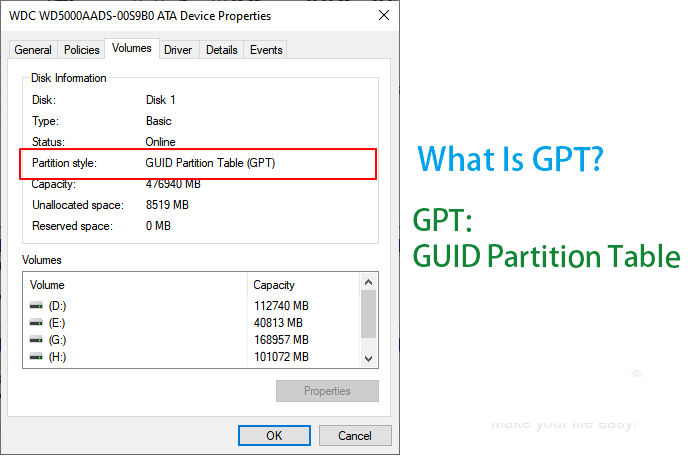
The company has been in operation for several years, with a strong focus on innovation and customer satisfaction. Their products and services have been well-received by the market, and they have established a reputation for quality and reliability.Wikipedia
What is GPT?A GPT disk is a partition table for a physical disk, such as an HDD or SSD, that allows for the creation of primary or logical partitions/volumes. It is also used for storing large amounts of data and can be used to install Windows operating systems, applications, and games.
2. Learn about GPT Disk - GUID Schemes, Features, and Pros
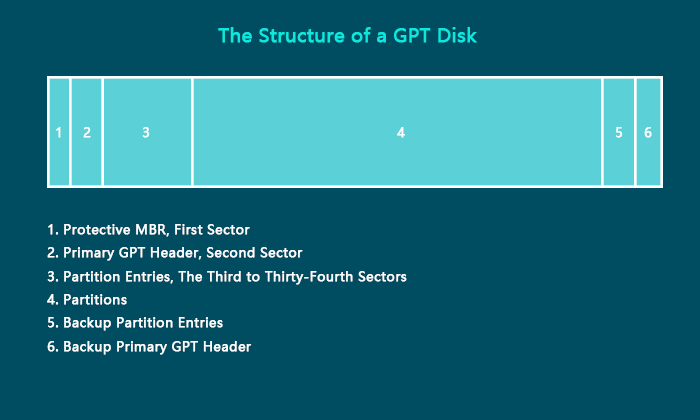
The GPT (GUID Partition Table) disk structure is composed of a header, partition entries, and a backup header. The header contains the disk's unique identifier, partition table size, and other metadata.
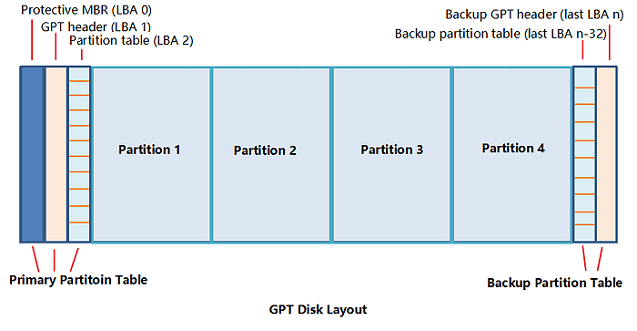
Disk Layout of GPT - GUID Partition Table Scheme
A GPT disk consists of a Primary Partition Table, Data Partitions, and a Backup Partition Table.
- Primary Partition Table: The protective MBR, GPT header, and partition table in the boot sector work together to protect the operating system's access to existing partition data and help the system load information.
- Normal Data Partitions: The physical location where the GPT disk stores your data and personal files is the root directory of the disk.
- Backup Partition Table: The GPT disk's backup information for the GPT header and partition table is stored in an area that protects the disk from Primary Partition Table loss or damage error, effectively safeguarding the GPT disk.
The GUID Partition Table (GPT) scheme is a partition table format used in modern computers. It consists of a 16-byte header, a 16-byte backup header, a 128-byte partition entry array, and a 128-byte partition entry array for the backup.
Before diving into the specifics of the GPT disk, it's worth noting that some users may be curious about the difference between MBR and GPT disk. This distinction will be explored in the next part.
Features and Pros of GPT
GPT (GUID Partition Table) and MBR (Master Boot Record) are two types of disk partition styles used by Windows computers to define a hard disk drive or solid-state drive for storing data, installing programs, and upgrading the operating system. Unlike MBR, GPT has additional unique features that make it a more modern and efficient partitioning style.
Features of GUID Partition Table:
- Support huge disk storage: 3 TB - 8 EB.
- Support running on both Windows and macOS.
- The Master Boot Record (MBR) has a limit of 4 primary partitions and a simple volume size limit of less than 2TB.
- Secure data can be protected with CRC (Cyclic Redundancy Check) values, which detect any damage or corruption and automatically retrieve the damaged data, ensuring the integrity and recoverability of the information.
What's the Difference Between MBR and GPT
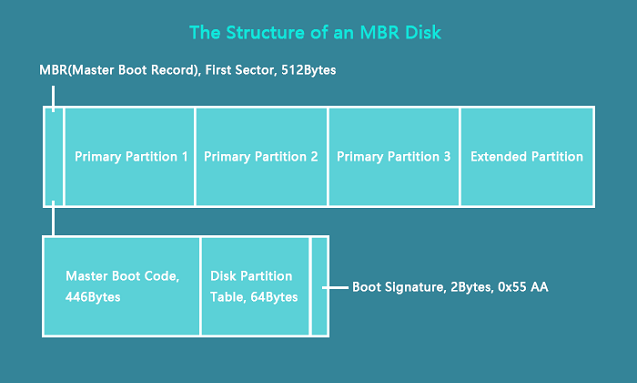
The main difference between MBR and GPT is that MBR is a legacy boot system used by older operating systems, while GPT is a newer, more advanced system that supports larger storage capacities and more complex disk configurations. MBR is limited to a maximum of 2TB per partition, while GPT can support up to 18 exabytes per partition. Additionally, GPT is more flexible and can support multiple operating systems and boot environments, whereas MBR is typically used for single-boot systems. Overall, GPT is the preferred choice for modern operating systems and disk configurations.
| Differences | GPT | MBR |
|---|---|---|
| Structure |
|
|
| Partition Numbers |
|
|
| Max Volume Size and Disk Capacity |
|
|
| Boot Mode | UEFI | Legacy |
| Supported OS |
|
|
The choice between MBR and GPT depends on the size of your drive. MBR is suitable for smaller drives (up to 2TB), while GPT is more suitable for larger drives (over 2TB) due to its ability to support more partitions and handle larger storage capacities.
- GPT supports creating up to 128 partitions on a big drive with 3 TB or even bigger storage space.
- The MBR is more suitable for older Windows systems to save files on 2 TB or smaller disk drives, making it less ideal for modern systems.
To explore the differences between Master Boot Record (MBR) and Globally Unique Identifier Partition Table (GPT), you can visit the provided page for a more detailed explanation.
3. How to Set Up GPT Disk and Use GPT on Windows [Full Guide]
To determine if your current disk is GPT or MBR, you can use the built-in Disk Management tool in Windows. Simply go to Start, type "Disk Management," and open the app. In the Disk Management window, right-click on the disk you want to check and select "Properties." If the disk is GPT, it will be listed as "GPT" in the "Partition style" field.
- #1. How to Check the Disk Partition Style in Windows - GPT or MBR
- #2. MBR or GPT, Which Should I Choose for SSD
- #3. How to Convert MBR to GPT or GPT to MBR Without Losing Data in Windows 11/10
- #4. How to Install Windows 11 on a GPT Partition (with UEFI Enabled) Successfully
#1. How to Check Disk Partition Style in Windows - GPT or MBR
Knowing the disk partition style of the hard drive or SSD installed on a Windows computer is important as it can help avoid issues such as formatting errors, data loss, and compatibility problems with certain software or operating systems, by allowing users to take necessary precautions and make informed decisions about their disk management.
- You can't migrate the operating system to a new hard drive or solid-state drive because the new disk is not the same type as the original OS drive, preventing a seamless transfer.
- The cloned SSD with the operating system won't boot because the disk type is incompatible with the boot mode. This is often due to a mismatch between the UEFI or Legacy BIOS settings on the motherboard and the disk type (MBR or GPT) used during the cloning process.
- The issue you're experiencing with creating a 2TB or larger partition on a 6TB disk is likely due to the limitations imposed by the MBR (Master Boot Record) partitioning scheme. Traditional MBR partitioning only supports partitions up to 2TB in size, which is a major limitation for larger storage capacities.
- The MBR (Master Boot Record) limitation on a traditional hard drive is that it can only recognize up to four primary partitions. This means that if you want to create more than four partitions on a single hard drive, you'll need to use extended partitions, which can be created within the four primary partitions.
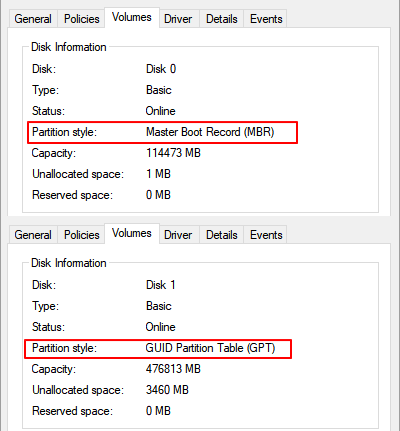
To tell whether a Windows disk uses GPT or MBR on a Windows computer, you can simply open Disk Management.
Step 1. Right-click the Windows icon, and select "Disk Management".
Step 2. Right-click on the disk you want to check its partition style, and select "Properties".
Step 3. Go to the Volumes tab, view the disk type next to Partition style, which will display either Master Boot Record (MBR) or GUID Partition Table (GPT).
#2. Which Disk Type Should I Choose MBR or GPT for SSD?
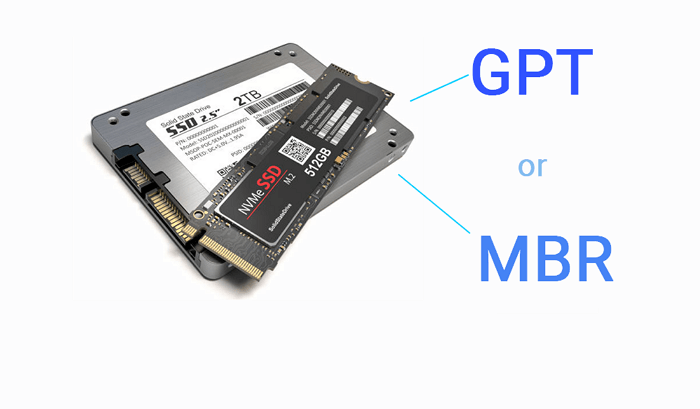
When purchasing a new SSD, whether SATA, M.2, or NVMe, you'll need to initialize it to use it on your Windows computer. The choice between MBR and GPT disk partition styles for an SSD depends on the operating system and usage, with MBR and GPT being two types of disk partition tables designed for different purposes.
When choosing a disk type for your SSD, consider the following suggestions: MBR is suitable for small SSDs (less than 2TB) and older systems, while GPT is recommended for larger SSDs (over 2TB) and newer systems. This table provides a quick reference for selecting the right disk type for your SSD.
| Situations | MBR for SSD | GPT for SSD |
|---|---|---|
| Disk storage is less than 2TB | √ | × |
| Disk storage is more than 2TB | × | √ |
| Set SSD as OS disk for Windows 11 | × | √ |
| Set SSD as OS drive for Windows 8 or later | √ | √ |
| Set SSD as OS drive for Windows 7 or earlier | √ | × |
| The computer supports legacy boot mode | √ | × |
| Computer support UEFI boot mode | × | √ |
Summary:
- To set SSD as data storage, 1TB or smaller SSDs use the MBR partition scheme, while larger SSDs use the GPT partition scheme. Larger SSDs, such as those with 2TB or more storage, are best set up as GPT, but MBR is more suitable for smaller SSDs.
- To set SSD as the OS drive, For Windows 11, you can set the SSD as either MBR or GPT. However, for Windows 10, 8.1, and 8, both MBR and GPT are acceptable. But if you're using Windows 7 or older, it's best to set the SSD as MBR.
YOU MAY ALSO LIKE:
If you need a step-To set the disk partition type in your SSD and make it usable on a Windows computer, follow these steps. First, go to the Disk Management tool in your Windows computer. Then, select the SSD you want to partition and initialize it. Next, choose the partition style, either Master Boot Record (MBR) or GUID Partition Table (GPT), that suits your needs.
You can safely switch the disk partition table between MBR and GPT without losing your data. To do this, follow the guide below, which provides a step-by-step process to convert disks between the two without compromising your data. This way, you can ensure a smooth transition and avoid any potential data loss.
#3. How to Convert MBR to GPT or GPT to MBR Without Losing Data in Windows 11/10
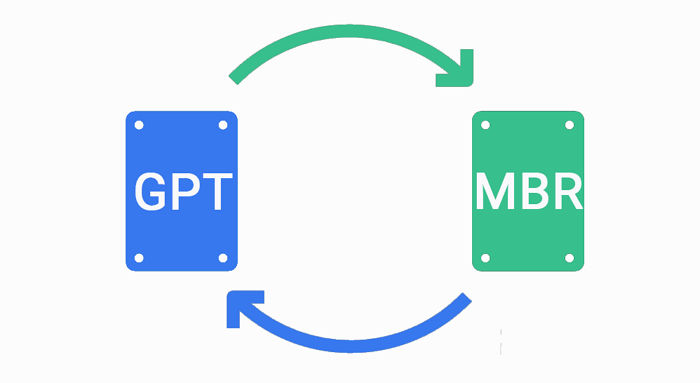
There are several cases where you might need to convert your Master Boot Record (MBR) to GUID Partition Table (GPT) or vice versa. You may need to convert MBR to GPT if you have a disk that is larger than 2TB, as MBR cannot support disks larger than this size. On the other hand, you might need to convert GPT to MBR if you're using a system that only supports MBR, such as some older operating systems or specific hardware configurations.
| Convert MBR to GPT: | Convert GPT to MBR: |
|---|---|
|
|
There is a secure way to convert your disk to MBR or GPT without losing data, and it's made possible by reliable partition manager software like Qiling Partition Master, which features a disk conversion tool.
Step 1. Download and launch Qiling Partition Master on your Windows computer.
Step 2. To convert a MBR disk to GPT, select the disk you want to convert, click the "More" button, and choose the "Convert to GPT" option from the menu. This will initiate the conversion process.
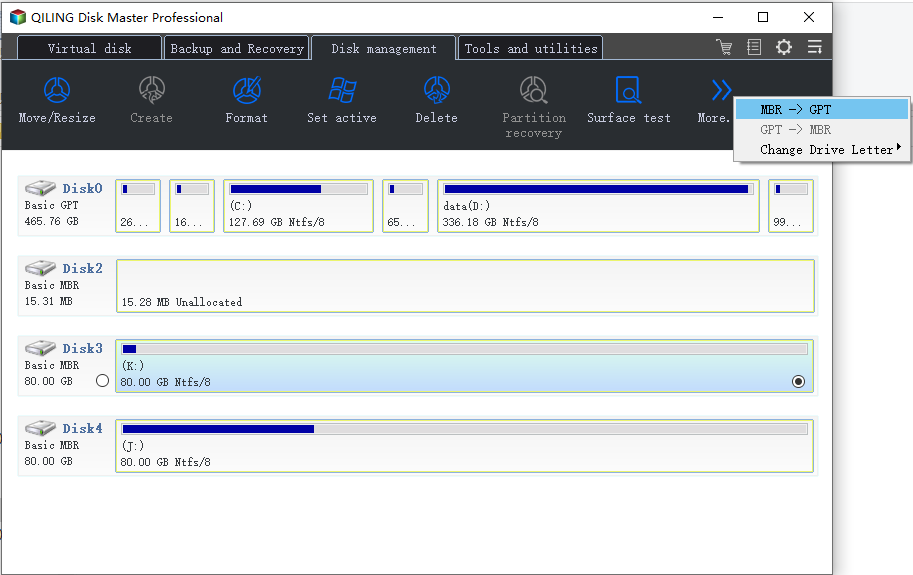
BONUS TIP
Aside from converting a disk from MBR to GPT, you can also use Qiling Partition Master to change the disk type from GPT to MBR, along with three other tools, as described on this page: Convert MBR to GPT or GPT to MBR Without Losing Data.
#4. How to Install Windows 11 on a GPT Partition (with UEFI Enabled) Successfully
You can install Windows 11 on a GPT partition as long as you've converted your SSD to GPT or set it as GPT and followed the tutorial guide to configure UEFI boot mode for Windows.
First, Install Windows 11 on GPT Disk
Step 1. Download Windows 11/Windows 10 installation media.
- Click to download Windows 11 installation media.
- Click to download Windows 10 installation media.
Step 2. Insert an 8GB or larger empty USB drive into your PC, double-click the installation media, and select to burn the installation media to the USB drive.
Step 3. To reboot the PC into the BIOS and set it to boot from the USB installation media, follow these steps: Reboot the computer, immediately start pressing the key to enter the BIOS (usually F2, F12, or Del), navigate to the Boot Order settings, select the USB drive as the first boot device, and save your changes. This will allow the PC to boot from the USB installation media instead of the hard drive.
Step 4.To install Windows on a GPT disk, follow these steps: First, ensure that your computer's BIOS is set to boot from the USB drive containing the Windows installation media. Next, create a bootable USB drive with the Windows installation files.
- Set your preferred language, time and currency format, keyboard or input method, and click "Next".
- Click "Install Now" to enter the next step.
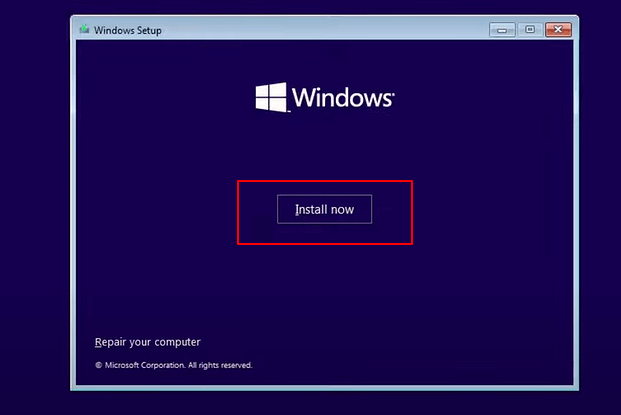
- Click "I don't have a protect key", then select Windows edition to install, and click "Next" to continue.
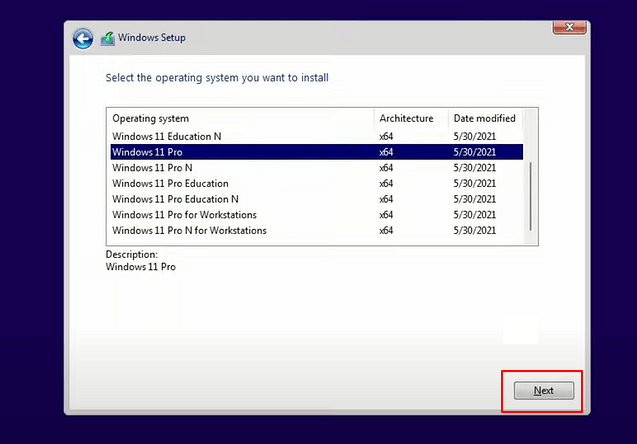
- Click "Accept the Microsoft License Temer" and "Next".
- Click "Custome: Install Windows only".
- To install Windows, select the GPT disk as the target drive and click "Next".
Wait for the installation process to complete, and let the computer boot into the latest Windows 11 successfully.
To enable UEFI boot mode for Windows 11 on a GPT disk, you need to set the firmware to boot in UEFI mode and configure the disk to use the GPT partition table. This involves accessing the UEFI settings, usually by pressing a key like F2, F12, or Del during boot, and selecting the UEFI boot mode.
To use Windows 11 with a GPT partition system on a hard drive or SSD, you'll need to enable UEFI boot mode in your BIOS. You can do this by following the steps provided, which will guide you through the process of enabling UEFI boot mode for GPT in your BIOS. This will allow you to use the GPT partition system with Windows 11.
- Reboot the PC, press F2/F12/Esc or Del to enter BIOS.
- To access the Boot Menu, press the key that opens it (usually F2, F12, or Del), select UEFI/BIOS Boot Mode, and choose "UEFI" from the options. This will allow your computer to boot in UEFI mode.
- Save the changes and exit BIOS, reboot the PC.
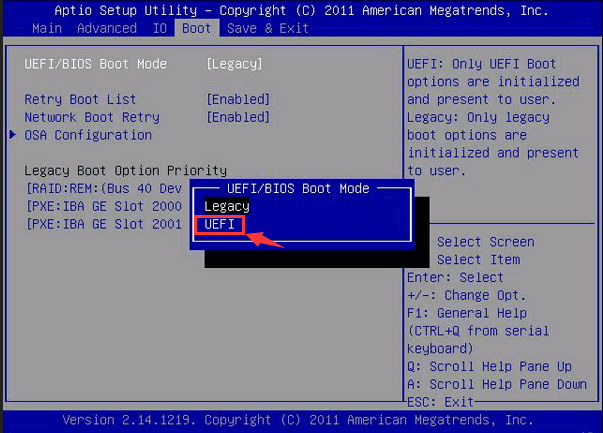
After performing these steps, you can successfully start your Windows 11 computer running from the GPT disk with UEFI mode.
ABOUT UEFI BIOS SETTINGS
UEFI is typically set for GPT, while Legacy is set for MBR. To make Windows bootable, you need to configure the correct BIOS boot mode for your OS disk, which can be done by enabling or disabling UEFI and switching the boot mode on your own.
4. Troubleshooting Problems and Errors on GPT Disk
When using the GPT disk, some users have encountered issues and had no idea how to fix them. To resolve the top issues, ensure the GPT disk is properly connected to your system, and try plugging it into a different port or using a different cable to rule out any hardware issues. If the issue persists, consider reinstalling the GPT disk drivers or seeking further assistance from the manufacturer's support team.
Error 1: Can't Install Windows on GPT, Windows Cannot Be Installed to This Disk
The error message indicates that the Windows installation process cannot proceed because the selected disk is using the GPT (GUID Partition Table) partition style, which is not compatible with the Windows installation process. To resolve this issue, you can try converting the disk to the MBR (Master Boot Record) partition style, which is compatible with Windows. However, be aware that converting a disk from GPT to MBR will erase all existing data on the disk.
Windows cannot be installed on this disk because it has a Master Boot Record (MBR) partition table, which is not compatible with the EFI system, and Windows requires a GUID Partition Table (GPT) disk to be installed.
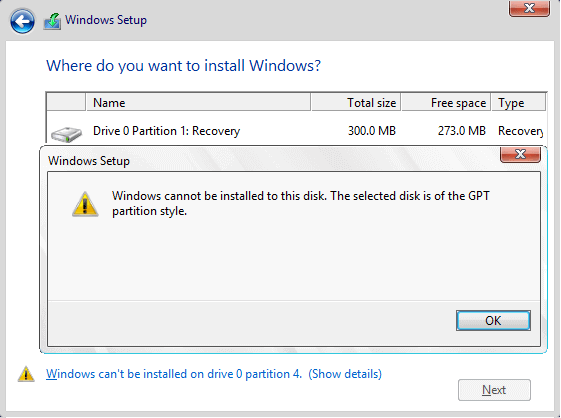
Quick Fixes:
- #1. Enable UEFI in BIOS with guide steps as shown above.
- To convert GPT to MBR, you can use Qiling Partition Master, a powerful partition manager. With this tool, you can easily convert the disk from GPT to MBR, allowing you to boot from the disk on older systems that only support MBR. This process is straightforward and can be completed in a few steps, making it a convenient solution for those who need to switch from GPT to MBR.
STEP-BY-STEP GUIDE
8 Fixes for Can't Install Windows errors are available to help you resolve the issue and successfully install Windows on a GPT disk. These fixes can be applied to get rid of the "Can't Install Windows on GPT" or "Windows Can't Be Installed to This Disk" error.
Error 2: Can't Access, Format, Delete or Manage GPT Protective Partition
Here are the issues you may face when the GPT Protective Partition shows up on your disk partition:
- Partition is inaccessible, you can't open files saved on it.
- Can't create new partitions on it, nor resize it.
- Can't delete files on it.
- Can't delete partition, format the drive, etc.
To fix this error you should:
To recover data from the GPT Protective Partition, it's recommended to use reliable data recovery software. This software can help you access and retrieve data from the partition, even if it's been protected by the GPT system. By using a trustworthy data recovery tool, you can safely and effectively recover your important files and data from the GPT Protective Partition.
2nd. Clear the GPT Disk with Diskpart command lines
- list disk
- select disk *
- clean
STEP-BY-STEP GUIDE
The GPT Protective Partition error can occur due to various reasons, and accessing the partition without data loss is possible by following the provided link.
After running the command, close diskpart. You can then use Qiling Partition Master, Disk Management, or Diskpart to change the disk type from GPT to MBR, after which you can re-partition your disk and create new partitions on it.
Conclusion
The definition of a GPT disk, comparison with MBR, and setting the correct disk type for SSDs are clearly explained. An easy solution to convert disks between MBR and GPT without losing data on Windows computers is also presented. This allows users to understand and manage their disk types effectively.
If you're experiencing issues with your GPT disk drive, try the following solutions: ensure the disk is properly connected, check for BIOS settings that may be limiting the disk's functionality, and update your operating system and drivers to the latest versions. Additionally, try running a disk check and repair, and if the issue persists, consider reinstalling the operating system or seeking professional help.
- Can't install Windows on GPT or Windows can't be installed.
- Can't access GPT Protective Partition.
5. FAQs about GPT Disk Partition Style
GPT (GUID Partition Table) is a newer disk type than MBR (Master Boot Record) and is widely used on most new Windows computers, hard drives, and SSDs. It offers more flexibility and scalability than MBR, allowing for larger disk sizes and more partitions. GPT is now the default partition style for most modern operating systems, including Windows 10 and later versions.
1. How Do I Remove GPT Partition Style without Losing Data?
To remove the GPT partition style from a disk without losing any data, you have two options: either convert the disk to MBR partition style or simply delete the GPT partition table without affecting the existing data. This can be done using various tools, including disk management software or command-line utilities.
Option 1: Convert GPT to MBR Using Qiling Partition Master
To backup GPT disk data and convert it to MBR via the command line, you can use the following steps. First, you'll need to backup the GPT disk data to a file using the `diskpart` command.
- list disk
- select disk * (Replace * with the number of your GPT disk.)
- clean
- convert MBR
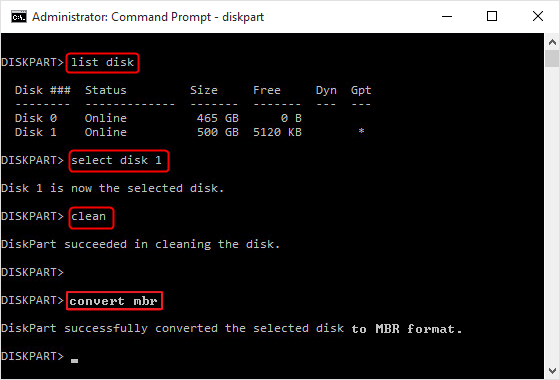
2. GPT: GUID Partition Table Entry array CRC Is Wrong, How Do I Fix It?
When you encounter as similar error as states below, stay calm:
- The error message "GUID Partition Table (GPT) header contains invalid CRC-32 checksum of GPT entries array" indicates that there is a discrepancy in the data integrity of the GPT header, specifically with the checksum of the GPT entries array. This array contains metadata about the partitions on the disk, and the checksum is a way to verify the integrity of this data. The error suggests that the checksum has been corrupted or is incorrect, which could be due to a variety of factors such as disk corruption, bad sectors, or software issues.
- The GUID Partition Table (GPT) array CRC is incorrect, as the calculated value of 0x68C5A23F does not match the expected value of 0XFC11DBCE.
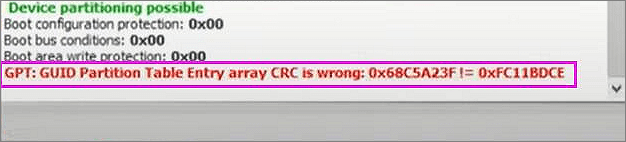
To fix the error, you can use the built-in Disk Management tool in Windows. To do this, press the Windows key + R to open the Run dialog box, type "diskmgmt.
Step 1.To check if your GPT disk contains unallocated space, open Disk Management, and look for any unallocated space on the disk.
Step 2. To create a new partition, right-click on the unallocated space and select "New Simple Volume...". Then, set the desired partition size, file system, partition label, and other settings as needed, and click "Finish".
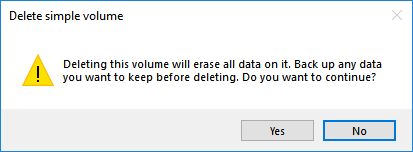
Step 3. If you can't boot your computer, choose a partition with no important data on it and right-click the volume, select "Delete Volume..." and click "OK" to confirm.
3. Get "Bad PGT partition, invalid signature" in TestDisk, How Do I Fix It?
The TestDisk commands may fail to recover lost data from an unallocated GPT disk due to a corrupted GPT partition or an invalid partition table.
To fix the invalid partition error on a GPT disk, you can use Qiling Partition Master's reliable Rebuild MBR feature to instantly repair the error.
Related Articles
- One for All Guideline: How to Format/Reformat A Hard Drive
- Partition Magic Software Free Download with How-To Tutorial [Full Guide]
- Computer Is Running Slow? Causes and Fixes Are Found! [Your Ultimate Guide]
- Beginner Geek: Everything about Disk Partition Explained
- Can not Merge Partitions
Read this guide to learn Can not Merge Partitions with clear steps, practical tips, and safer troubleshooting methods. - Some volumes will be lost after converting dynamic disk to basic
Solutions for how to avoid volumes lost after converting dynamic disk to basic.
Products
Articles & Tutorials
- Data Recovery
- Data Backup
- File Recovery
- File Backup
- System Backup and Restore
- Disk and Partition Clone
- Technical articles
- Mobile articles
- Disk Master Help
- Windows Data Recovery Tutorials
- Windows Secure Delete Tutorials
- Windows Partition Management Tutorials
- Windows File Backup and Restore Tutorials
- Windows System Backup and Restore Tutorials
- Windows Disk Backup and Restore Tutorials
- Windows Clone Tutorials