What is Dynamic Foreign Disk, How to Import Foreign Disk Without Data Loss
| Workable Solutions | Step-by-step Troubleshooting |
|---|---|
| How to Import Foreign Disk in Two Ways |
Method 1. Import foreign disk in Disk Management....Full steps Method 2. Import foreign disk by using Diskpart....Full steps |
| Convert Dynamic Foreign Disk to Basic Disk Without Data Loss | Partition Master Step1: Install and open Qiling Partition Master on your Windows computer....Full steps |
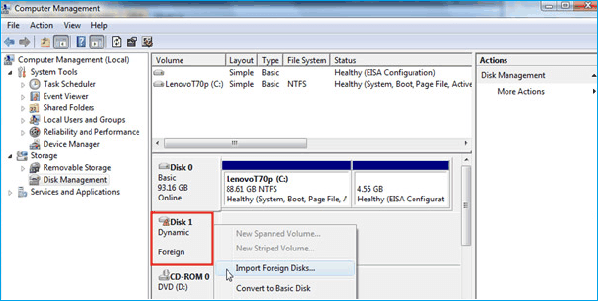
Disk 1 Dynamic Foreign
A dynamic disk that's showing as "Foreign" in Disk Management on Windows 10 means it's not initialized as a dynamic disk on the new PC. To access the data, you'll need to add the disk as a dynamic disk on your new PC. You can do this by right-clicking on the disk in Disk Management, selecting "Initialize," and then "Convert to Dynamic Disk." This should allow you to access your data. However, please note that if you're converting a disk from basic to dynamic, you won't be able to convert it back to basic, so make sure you're okay with the data being on a dynamic disk. If you're still having issues, you may want to try checking the disk's properties or running a disk check to see if there are any issues with the disk itself. If you're still stuck, feel free to ask and I can try to help further.
What Is Dynamic Foreign Disk
When moving a dynamic disk from one computer to another, especially if the new computer doesn't support dynamic disks (like all Windows home editions), the disk created on the previous computer will be flagged as a "foreign" disk in Disk Management. This is because dynamic disks aren't supported on Windows XP Home Edition or portable computers. If your computer is dual-booting and one of the operating systems doesn't support dynamic disks, the disk will also show as foreign. This usually happens when the disk is created on a system that doesn't support dynamic disks or when the disk is moved to a system that doesn't support it.
- The dynamic disk comes from another computer that has installed Windows 2000, Windows XP 64-bit Edition (Itanium), Windows XP Professional, or Windows Server 2003 family operating systems.
- Computers can be set up to run two operating systems, including Windows XP Home Edition and another OS, but this is not possible on Windows XP Home Edition or portable computers due to its inability to support dynamic disks, which are used by other OSs like Windows 2000 Professional or Windows XP Professional.
How to Import Foreign Disk Without Losing Data
When your dynamic disk is showing foreign, the data on the disk is still there but invisible. Follow instructions describing how to move and import foreign disk in two ways below.
1. How to Import Foreign Disk in Two Ways
Import foreign disk in Disk Management
To access data on a disk, you need to add it to your system configuration. This can be done in Disk Management by right-clicking the foreign disk and selecting "Import Foreign Disks", which makes any existing volumes on the disk visible and accessible.
Import foreign disk by using DiskPart
- Type CMD in the search box, open Command Prompt as Administrator, and then type diskpart and press Enter.
- Type list disk and press Enter
- To move a disk, you need to select the disk you want to move by typing `select disk n` and pressing Enter, where `n` is the disk number of the disk you are moving.
- Type import [noerr] and press Enter
Does import a foreign disk destroy data?
Adding a dynamic disk to your system configuration is harmless and won't destroy any data. However, if you're on Windows XP Home, you won't be able to use the disk again through the "Import Foreign Disks" feature, and the only way to reuse it is to erase all data and convert it to a basic disk, which would result in data loss. The steps for this process are as follows.
- Right-To convert a dynamic disk to a basic disk, click each volume on the dynamic disk you want to convert, and then click "Delete Volume" for each volume on the disk. This will remove the dynamic disk structure and allow you to convert the disk to a basic disk.
- When all volumes on the disk have been deleted, right-click the disk and click "Convert to Basic Disk".
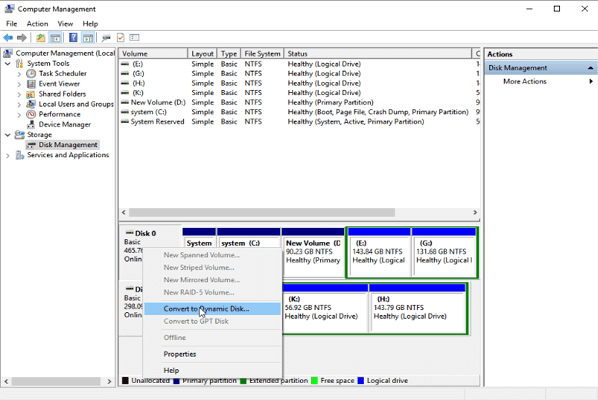
If you want to convert a dynamic disk to a basic disk without losing data, you can use the built-in Disk Management tool in Windows. To do this, you'll need to disconnect the dynamic disk from the system, then use the Disk Management tool to convert it to a basic disk. This process will allow you to convert the dynamic disk without losing any data, and you can then use the converted disk as a basic disk for your system.
2. Convert Dynamic Foreign Disk to Basic Disk Without Data Loss
Qiling Partition Master is a powerful disk partition management software that supports various Windows versions and offers features like resizing, creating, formatting, deleting, copying, and merging partitions, as well as migrating OS to SSD and converting file systems and disk types.
Regardless of the version of your computer, you can directly import a foreign disk by converting it to a basic disk without losing any data.
Step 1. Install and open Qiling Partition Master on your Windows computer.
Step 2. To convert a disk to a different format, select the disk you want to convert, right-click it, and choose the conversion option from the context menu. This will initiate the conversion process.
- Basic to Dynamic: right-click a basic disk and select "Convert to Dynamic".
- Dynamic to Basic: right-click a dynamic disk and select "Convert to Basic".
Step 3. Click "OK" on the pop-up notice window and it will begin to convert the basic disk to dynamic or dynamic to basic.
Import Foreign Disk FAQs
1. What is import foreign disk?
Import a foreign disk:
When moving a dynamic disk from one computer to another, it's flagged as a "foreign" disk in Disk Management. To access it, you need to import it first. This process allows the new computer to recognize and utilize the dynamic disk.
2. How do I fix a foreign disk?
Import the foreign disk
To access data on a disk, you need to add it to your computer's system configuration. This can be done in Disk Management by right-clicking the foreign disk and selecting "Import Foreign Disks". Once this is done, any existing volumes on the foreign disk become visible and can be accessed.
3. Does import foreign disk destroy data?
When importing a foreign disk on Windows computers (excluding Windows XP Home), your data will remain safe and intact. However, if you're using Windows XP Home, you can use Qiling Partition Master to convert the dynamic disk to a basic disk without losing any data.
Related Articles
- Top 5 Reliable Software to Check Hard Disk Health for Free
- Free Download SD Card Formatter: All Memory Card Format Software Free Download
- How to Delete All Partitions on Windows 11
- [Tested & Effective] Delete All Partitions on Windows 11/10/8/7 PC at One Time
- Upgrade BIOS to UEFI Before You Want to Convert MBR to GPT
How to upgrade BIOS to UEFI before converting MBR to GPT? In this post, detailed steps will be given to help get it done easily. - Legacy VS UEFI VS Legacy+ UEFI:Which One Should You Choose?
What is Legacy and UEFI? What's the difference between Legacy and UEFI? This tutorial will explain to you in detail and show you how to boot from Legacy or UEFI.
Products
Articles & Tutorials
- Data Recovery
- Data Backup
- File Recovery
- File Backup
- System Backup and Restore
- Disk and Partition Clone
- Technical articles
- Mobile articles
- Disk Master Help
- Windows Data Recovery Tutorials
- Windows Secure Delete Tutorials
- Windows Partition Management Tutorials
- Windows File Backup and Restore Tutorials
- Windows System Backup and Restore Tutorials
- Windows Disk Backup and Restore Tutorials
- Windows Clone Tutorials