How to Merge Partitions in Windows 11/10/8/7
Merge Partitions Windows 11/10 Quick Navigation
Merging partitions on computer hard drives is a growing trend, making it a necessity for users to combine partitions without losing data. Fortunately, it is possible to merge partitions in Windows 11/10, and there are three main situations where this is applicable. To achieve this, users can utilize partition manager software, such as Qiling, to combine two partitions without losing any data.
- Merge Two Adjacent Partitions
- Merge Two Non-Adjacent Partitions
- Merge Cross-Disk Partitions
- Reasons to Merge Partitions
- How to Utilize Disk Space Better
Applies To:Two or more partitions, whether adjacent or not, can be created.
Tool You Need: Qiling Partition Master or Windows 10 Disk Management
To achieve your specific goal, first identify what you need, and then take the exact steps to get it. This will ensure you're on the right track and avoid unnecessary detours.
1. Merge Two Partitions Adjacent in Windows 11/10/8/7
You have two options to merge Windows partitions, but using third-party software is generally simpler than using Disk Management. To merge partitions, you can either use a third-party software or the built-in Disk Management tool in Windows, but the former is often a more straightforward and efficient approach.
Option 1. Merge Two Partitions with Qiling Partition Master
Merging two successive partitions is a straightforward task for Qiling Partition Master, an all-in-one partition merger that supports almost all 32/64-bit Windows operating systems, including Windows Vista/XP/7/8/10/11 and Windows Server 2003-2019. This tool allows for seamless merging of 2 partitions without losing any data, making it a reliable solution for users.
Unlike Disk Management, Qiling Partition Master allows you to combine two adjoining partitions directly without deleting one to create a new space, making the process more efficient.
- Qiling Partition Master -
Your Smart Windows 11 Update Disk Manager
- MBR to GPT Converter, Make Disk Ready for Windows 11.
- Migrate Windows 11 to New SSD in 1-Click.
- Handy to Extend orCombine Partitionsin Windows 11.
- Clone and Upgrade Disks without Data Loss.
Step 1: Select a neighbor partition to merge
Select the next partition next to the former selected partition and click "Move/resize" to continue.
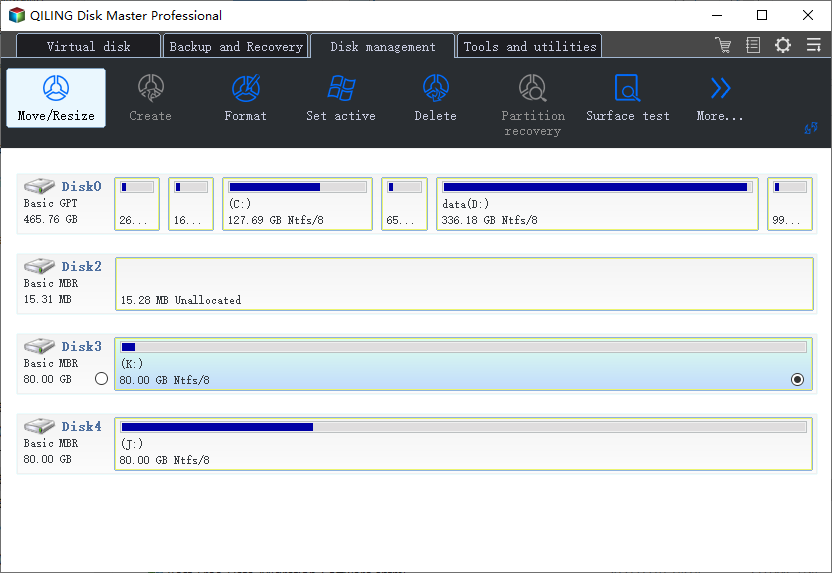
Step 2.Drag the neighbor partition end into the itself space.
To shrink the system partition, drag its end into the unallocated space, and then click "Proceed" to initiate the resizing process.
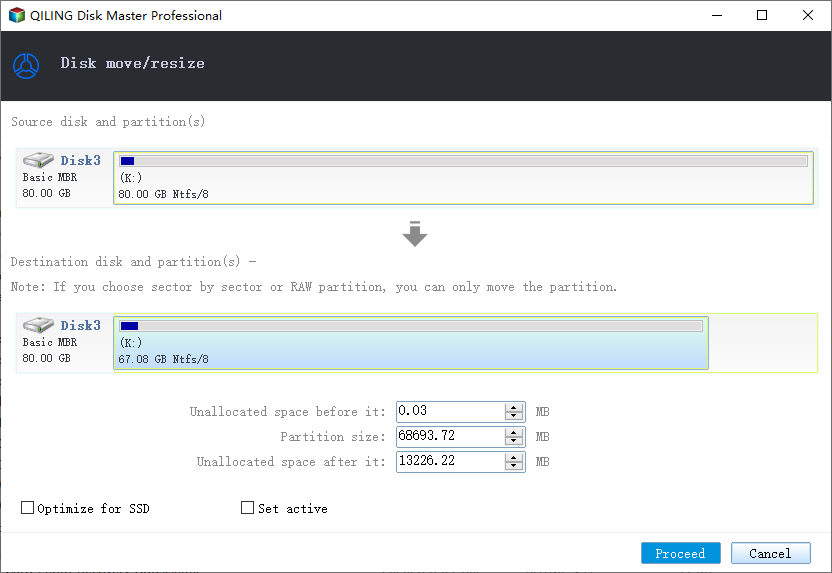
Step 3: Select the target partition
To add space to a partition, select the partition you want to add space to and keep, then click on "Merge".
Step 4.Drag the system partition end into the unallocated space.
To resize the system partition and add it to the C: drive, simply drag the system partition end into the unallocated space, effectively merging the two, and then click "Proceed" to initiate the resizing process. This will allow the C: drive to expand into the newly freed space.
Aside from merging partitions, Qiling Partition Master can also be used to partition a hard drive on your own. The software allows you to resize a partition, create a new partition, and delete an existing partition in Windows with just a few clicks.
Option 2. Combine Two Partitions as One in Disk Management
In order to merge partitions in Windows 10 using Disk Management, you must first back up your data as deleting the target partition is required to create unallocated space, which is then used to extend the source partition. This process can be completed manually or with the aid of free backup software, after which you can proceed with merging the partitions.
Also read:How to back up files automatically.
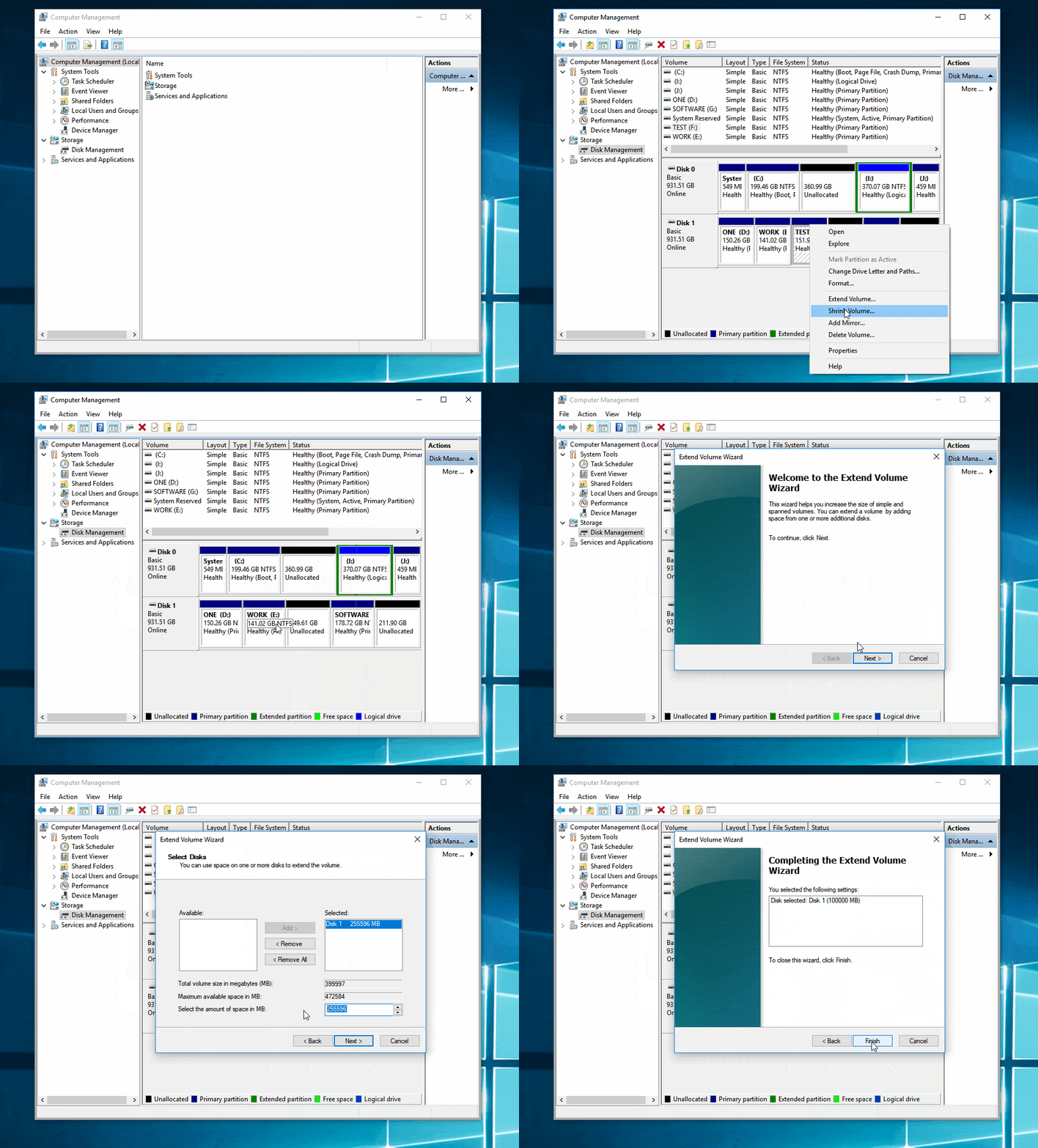
Step 1.Right-click on "This PC" and choose "Manage" > "Disk Management".
Step 2.To delete a target partition, right-click on it and select "Delete Volume". Then, in the confirmation prompt, click "Yes" to proceed with the deletion.
Step 3.Right-click the source partition and choose "Extend Volume".
Step 4. In Extend Volume Wizard, click "Next".
Step 5. Set the amount of space and click "Next" in the "Select Disks" window, noting that the maximum available space refers to the total size of unallocated space in the current disk.
Step 6. Once you've installed the software, click "Next" > "Finish" and wait for the process to complete.
2. How to Merge Two Non-Adjacent Partitions
Both Qiling Partition Master and Windows built-in Disk Management can merge two partitions that are not next to each other. Using Disk Management to combine non-adjoining volumes is the same as combine two adjacent ones, which you can refer to Option 2 (delete the target partition and then extend the source partition). The way to merge non-adjacent partitions with a professional partition merger varies depending on what is between your source partition and target partition. I'll explain it in detail.

If there is unallocated space between your source and target partitions, you can directly merge them without deleting any existing volume, and the unallocated space will be added to the combined partition. For example, you can merge C and D drives together.
To merge two non-adjacent partitions in Windows 10, you can use the built-in Disk Management tool. First, open Disk Management by searching for "Disk Management" in the Start menu. Next, right-click on the partition you want to allocate space from and select "Allocate Space." This will move all the free space from the selected partition to the target partition, without merging the two partitions. The data will still exist in the old partition. This feature is useful for redistributing free space between partitions, but it does not merge the partitions themselves. If you need to merge partitions, you should delete the target partition using Disk Management and then recreate it to combine the free space.
Step 1.The user should click on the D: partition which has enough free space and select the option "Move/resize".
Step 2.To resize the partition, drag the strong end of the partition into the itself space to shrink it, and then click "Proceed" to initiate the resizing process.
Step 3.Select the target partition, which is the C: drive, and drag the partition panel to the right to add the free space from the D: drive to the C: drive. Once you've done that, click "Move/resize" to confirm the changes.
Step 4.To expand the C: drive, drag the system partition end into the unallocated space to add it to the C: drive, then click "Proceed" to start the process of moving free space from D: drive to C: drive.
3. How to Merge Two Cross-Disk Partitions
The precondition for cross-To combine disks, they must be dynamic disks, which support cross-disk volumes like spanned and striped volumes. If you want to merge partitions on different disks, ensure the disks are dynamic or convert basic disks to dynamic disks first.
To combine two partitions on different disks, you can either use Qiling Partition Master or Disk Management. A detailed guide on merging disk 0 and disk 1 is available, providing step-by-step instructions.
Additional Information: Reasons to Merge Partitions in Windows 11/10
Merging partitions is a convenient behavior that combines two partitions into a bigger one, making it increasingly popular. Users can enjoy merging partitions on one or more hard drives, and do so for three main reasons: to consolidate space, simplify storage, and reduce clutter in their Windows system.
- To Increase Free Space
It's common for one or more partitions on your computer's hard drive to run out of space, especially the C drive. To address this issue, you can consider merging partitions, which allows you to add more free space to the source drive, effectively extending the system partition or data partition.
- To Save Files More Conveniently
Many gamers and users prefer to save their game data on a single hard drive, which is often pre-partitioned by manufacturers, leading them to merge partitions for easier management of their game data, usually measured in gigabytes.
- To Locate Files More Quickly
Even if you divide your hard drive into multiple partitions, you often end up storing files randomly across them, making it hard to find specific files or folders when you need them. To save time searching, consider combining partitions to reduce the number of volumes.
To merge partitions in Windows 10, you can attempt to resize your partitions by adding one to another, which can be achieved by following the methods above, regardless of whether your intention is the same as one of the three reasons listed.
Extra Tips: How to Utilize Disk Space Better
To make the most of your available disk space, consider implementing some space-saving strategies. One approach is to regularly clean up your computer by deleting unnecessary files and documents, and also consider compressing your files to save space.
Learn how to resize your partition:Common resizing operations such as merging, extending, or shrinking partitions can help create free space on your computer. This free space can then be used for data storage, balancing the usage of partitions on your hard drives. For example, if a partition is running low on space, you can merge it with another partition or extend it using unallocated space. Alternatively, if there's no unallocated space available, you can shrink a partition to free up space, eliminating the need for completely blank or out-of-space partitions on your hard drive.
Clean the junk files and useless data on your disk:Don't let useless files take up your disk space. Remove items you don't need or junk files produced by programs to keep your computer storage organized and prevent it from becoming slow.
Defragment drives regularly:Defragmentation is the process of reassembling a file that is scattered across the hard drive, organizing disk data in a more efficient manner to improve read and write speeds. To defragment a disk partition, you can use various methods, such as running a disk defragmenter software or using built-in operating system tools. This process helps to put the file back together, making it easier for the computer to access and use the data. By defragmenting your disk partition, you can experience improved system performance and faster data retrieval.
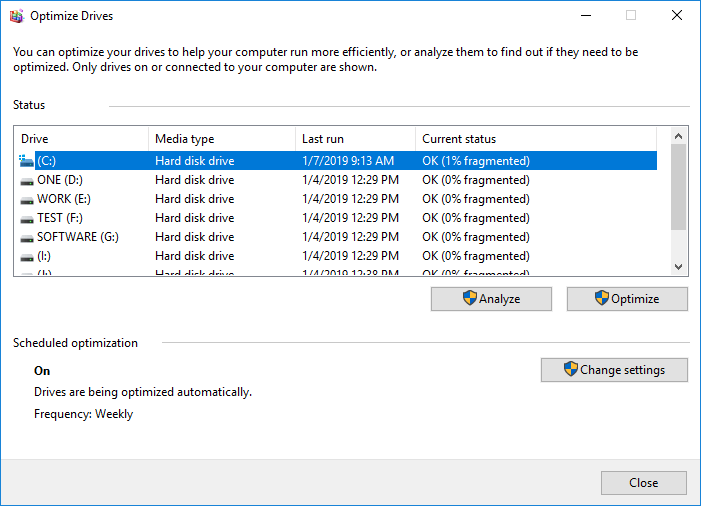
Step 1.Input defrag in the search bar.
Step 2.Choose "Defragment and Optimize Drives" in the search result.
Step 3.Select the hard drive you want to optimize and click the "Optimize" button.
The Bottom Line
You now know two tools to merge partitions into a single larger one: Qiling Partition Master and the Windows inbuilt Disk Management. While both can merge partitions, there are notable differences in their application. For instance, if you want to merge adjacent partitions, Qiling Partition Master allows you to do so without deleting your target partition, unlike Disk Management. Even if Qiling Partition Master requires deleting a partition, you can use free backup software to back up your files effectively. Ultimately, choose the partition management solution that best suits your needs.
FAQs - Merge Partitions Windows 11/10 Without Losing data
If you still have some questions, you can read these frequently asked questions and solve your problems now.
Can you combine partitions without losing data?
You can merge two partitions without losing data using Qiling Partition Master, a professional partition manager. To do this, follow these steps:
Step 1.Install and launch Qiling Partition Master on your PC.
Step 2.Select partitions to merge.
Step 3.Merge partitions.
The program will merge space from the second partition and add files from the second partition to the first partition.
How do I merge partitions?
To Combine partitions in Disk Management:
1. Press the Windows key and the X key on your keyboard, then select Disk Management from the list.
2. Right-click drive D and select Delete Volume, which will convert the disk space of D to Unallocated.
3.Right-click drive C and select Extend Volume.
4.Click Next in the pop-up Extend Volume Wizard window
5.Click Finish to execute.
In a while, drive D is merged into C drive.
Can I merge C and D drives?
Many people know that Windows' built-in Disk Management can help merge C and D drives in Windows 10 for free, but it has its own drawbacks. The program requires deleting the other partition before merging the drives, which can be inconvenient. A more convenient option is to use Qiling Partition Master, which can merge C and D drives without data loss.
Does deleting a partition erase data?
To delete a primary partition, you'll need to erase your hard drive and start over, permanently erasing any data on it.
Related Articles
- How to Convert MBR to GPT Using CMD in Windows 11
- SSD Health Check Software Free Download in 2022
- What Is Surface Test? How to Do Disk Surface Test HDD/SSD on Windows 10
- How to Find Hidden Partition or Hide Partition in Windows 10/8/7
- How to Decrypt and Format Encrypted SD Card [2022 Updated]
When your SD card gets encrypted, you cannot directly format encrypted SD card. You'll have to decrypt the SD card first and then format it. On this page, you'll learn the full process of decrypting SD card even without a password and format the encrypted SD card to a normal state again. - Format RAW SD Card/USB Drive in Windows 11/10/8/7
To format a RAW SD card, USB flash drive, pen drive, or RAW partition, you can use a RAW SD card formatter or Qiling Partition Master. This software allows you to easily format the device to FAT32, NTFS, EXT2, or EXT3 in Windows 11/10/8/7.
Products
Articles & Tutorials
- Data Recovery
- Data Backup
- File Recovery
- File Backup
- System Backup and Restore
- Disk and Partition Clone
- Technical articles
- Mobile articles
- Disk Master Help
- Windows Data Recovery Tutorials
- Windows Secure Delete Tutorials
- Windows Partition Management Tutorials
- Windows File Backup and Restore Tutorials
- Windows System Backup and Restore Tutorials
- Windows Disk Backup and Restore Tutorials
- Windows Clone Tutorials