Internet Explorer History, Statistics & Facts
Internet Explorer is an obsolete browser made by Microsoft. So, let's explore the life of this browser that everyone knows.
Microsoft announced the end of life for Internet Explorer in May 2021, marking the end of an era for the iconic browser that had been a default in-built program for web exploration since 1995. Despite being replaced by other browsing programs over the years, IE remains a nostalgic reminder of the early days of the internet.

The end of Internet Explorer marks a significant milestone, but its legacy is complex. While it wasn't always the best browser, its impact on the internet community will be felt. Many remember browsing the internet with IE, and its influence extends beyond functionality to pop culture, with memes and references still floating around. The program's end of life will have a lasting effect, not just on tech enthusiasts but also on the broader internet landscape.
Therefore, let us dive in and analyze some of the key aspects of this browser, which comes to an end on June 15, 2022.
I: Introduction
Internet Explorer was released in 1995 as part of the "Plus! for Windows 95" package and has been the primary browser in Windows computers ever since.
By 1999, the costs of Internet Explorer (IE) were estimated to be around $100 million per year, accounting for development, management, updates, and personnel expenses, including reimbursement for over a thousand people involved in the project.
This tool has been a laughingstock for years, with its slow and unchanging nature being the subject of many memes. Despite its comedic value, it's also been a source of sadness for many, particularly given its 27-year history. The tool's eventual demise was likely a result of its slow evolution and inability to keep up with changing times.
II: Internet Explorer Version History
Microsoft released the first stable version of Internet Explorer, called "Plus!", in the same year as Windows 95. A new version, 1.5, was released less than six months later.
Microsoft continued to provide upgrades to IE over the years, releasing at least two stable versions each year until 2013, when the final version was released, which still works as of June 15, 2022.
Here are the 11 main versions of Internet Explorer released from 1995 to 2013:
a. Microsoft Internet Explorer 1.0 - released on August 16, 1995
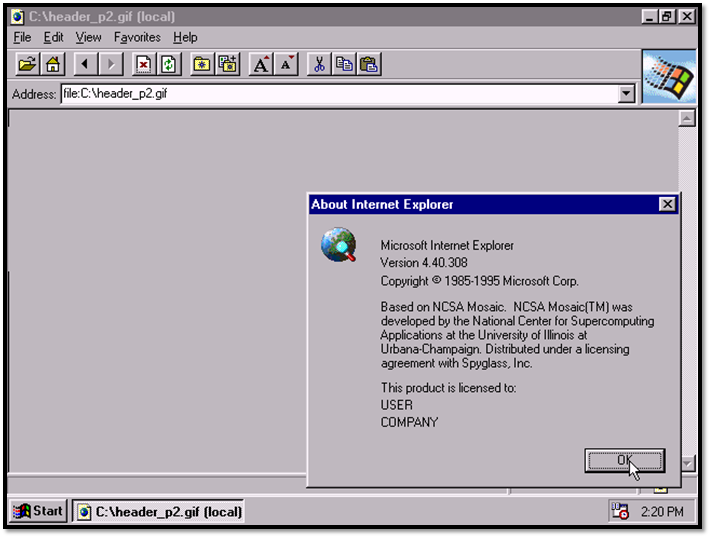
b. Microsoft Internet Explorer 2 - released on November 22, 1995
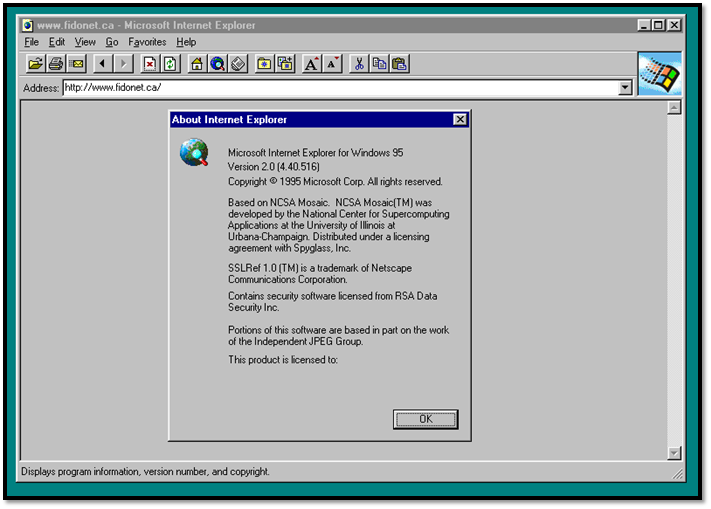
c. Microsoft Internet Explorer 3 - released on August 13, 1996
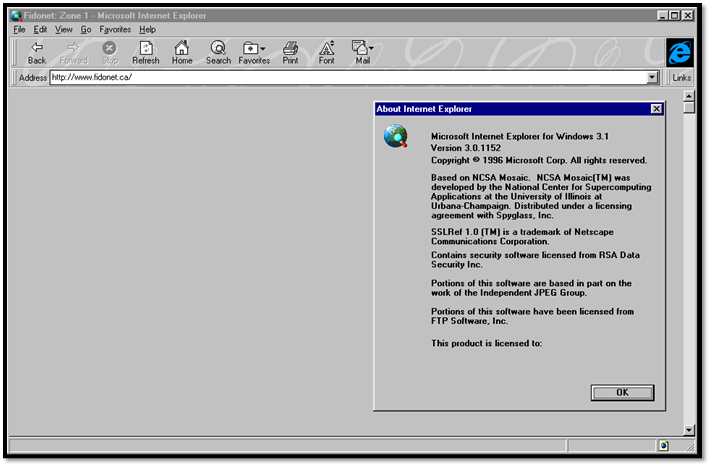
Image credit: Wikimedia.org
d. Microsoft Internet Explorer 4 - released on September 1997
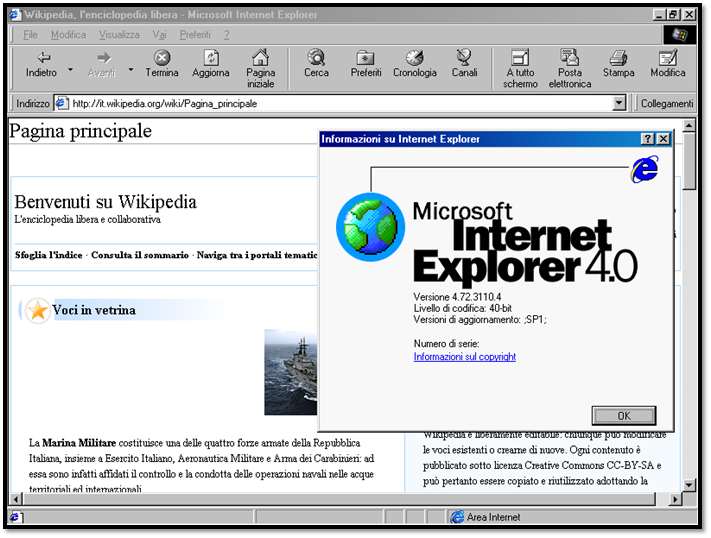
Image credit: Wikimedia.org
e. Microsoft Internet Explorer 5 - released on March 18, 1999
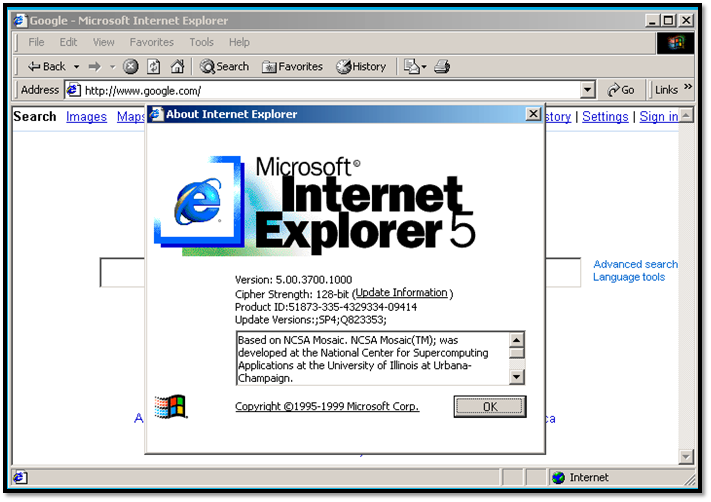
This version is where visual changes started to appear.
f. Microsoft Internet Explorer 6 - released on August 24, 2001
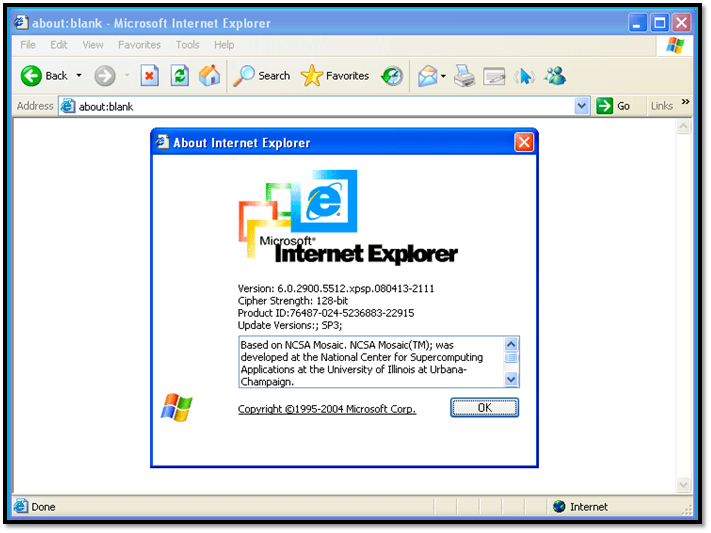
Internet Explorer 6 was the most widely used version, coming pre-installed with Windows XP, making it a staple of many users' computers.
g. Windows Internet Explorer 7 - released on October 18, 2006
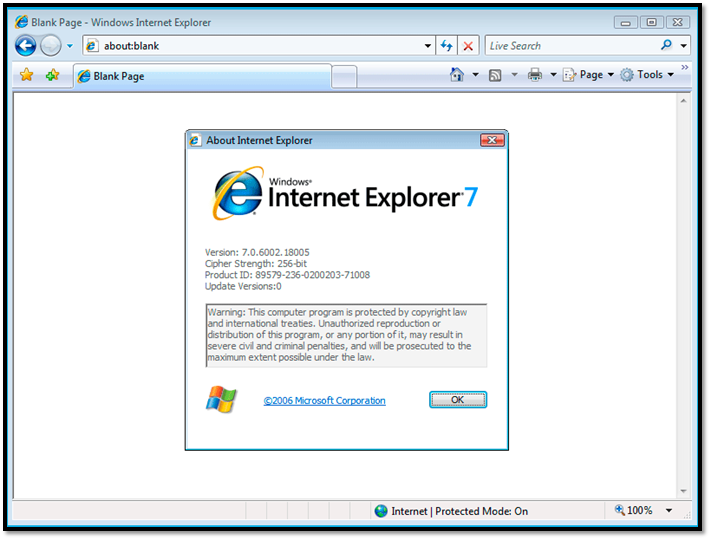
The gap between two Internet Explorer releases was 5 years, from 2001 to 2006, suggesting a decline in its usage and the rise of third-party browsers.
h. Windows Internet Explorer 8 - released on March 19, 2009
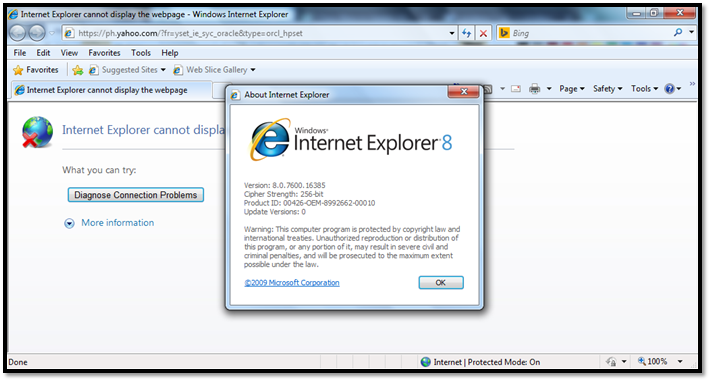
This version came in-built with Windows 7 RTM and so on.
i. Windows Internet Explorer 9 - released on March 14, 2011
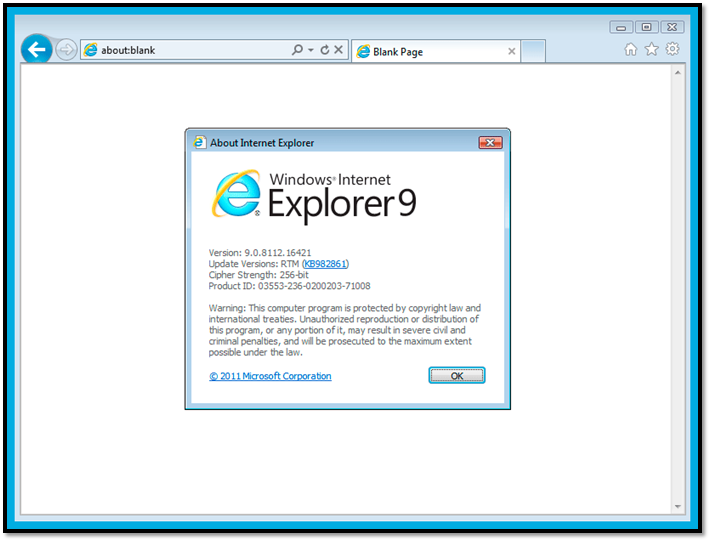
j. Windows Internet Explorer 10 - available on October 26, 2012
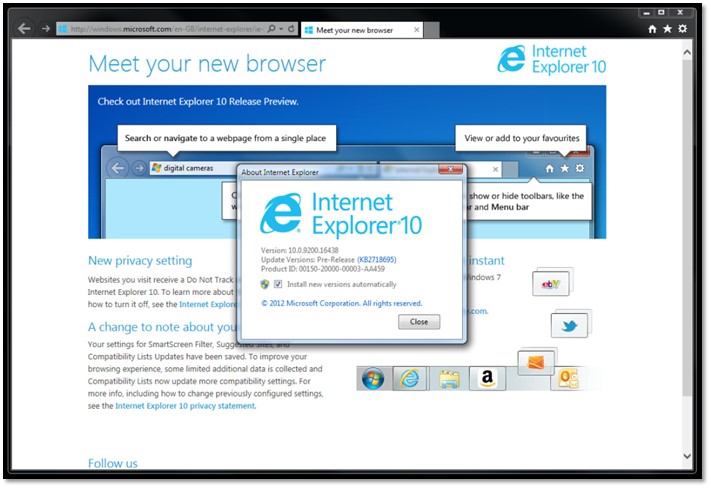
k. Internet Explorer 11 - released on October 17, 2013
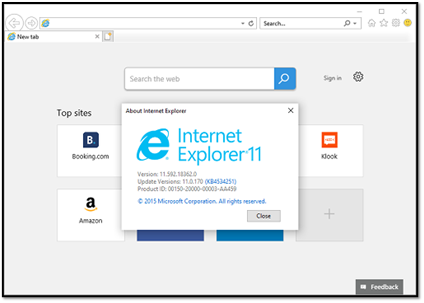
l. End of life - June 15, 2022
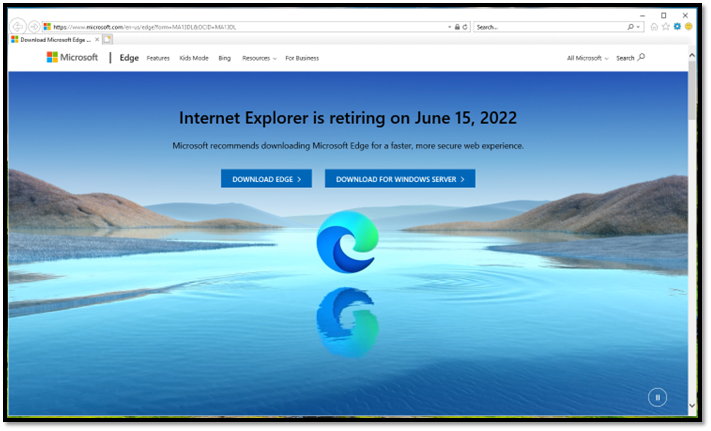
Internet Explorer, the web browser developed by Microsoft, is nearing its end of life, with support ending on June 15, 2022. As a result, users are advised to switch to alternative browsers like Microsoft Edge, Google Chrome, or Mozilla Firefox for a more secure and up-to-date browsing experience.
Over its 26-year history, Internet Explorer's design has undergone significant changes, with notable improvements in visual appeal after 2006. However, this coincided with a decline in user base, largely due to the rise of competing browsers like Firefox (2006) and Chrome (2008) that eventually surpassed Internet Explorer's popularity.
Windows 7 will stop receiving security updates in January 2023, and while some computers may still run it until 2023, its support will end soon after.
Many media channels, such as the BBC, have reported that this is the second goodbye for Internet Explorer, citing Microsoft's decision to effectively end IE's life after its final version over 8 years ago, when it was succeeded by Microsoft Edge.
III: Internet Explorer Logo History
The logo for Microsoft's Internet Explorer underwent several changes over its 18-year lifespan and 26-year support period. Initially, the logo was simply the program's name, which was released with Plus! for Windows 95.
However, perhaps the most renowned IE logo was from the 2003-2005 era. To help you understand, here are a few logo designs for IE over the years.
a. 1995 – 1996 (Microsoft Internet Explorer 1)

The initial logo for Plus! was used in the Windows 95 version, featuring the Plus! branding prominently.
b. 1995 – 1996 (Microsoft Internet Explorer 2)

c. 1996 – 2001 (Microsoft Internet Explorer 3)

d. 1997 – 2005 (Microsoft Internet Explorer 4 – 7 Beta)

e. 2001 – 2006 (Microsoft Internet Explorer 6 – 7 Beta)

f. 2003 – 2005 (Microsoft Internet Explorer 6.05 - 7 Beta)

The only logo design from this list that was unused, despite being used in some beta versions in 2005.
g. 2005 – 2011 (Windows Internet Explorer 7 - 8)

The logo was a prominent symbol of Internet Explorer for many years, first introduced with IE7 in Vista and later reused in IE8.
h. 2011 – 2022 (Windows Internet Explorer 9 - 11)

The last version of IE logos was released in Windows 7, but instead of updating it for Windows 10, it was reused from Windows 7.
i. 2012 – 2022 (Internet Explorer 10 – 11)

The primary IE logo in Windows 8 was replaced by the 9-11 version in later Windows 10 releases.
The IE logo, represented by the letter E, became closely associated with the internet and was initially included on desktop computers starting from 2001. However, over time, it was only available on desktops if users specifically chose to add it.
IV: Internet Explorer Users (How many people are using IE?)
Internet Explorer's user base has been steadily declining since its peak in the early 2000s, despite improvements in its 10 and 11 releases, which failed to reverse the trend.
The internet search term peaked in usage almost 8 years ago, shortly after its release. Since then, the numbers have declined steadily, with the current usage being significantly lower than its peak. You can see the downward trend for yourself.
| Year | Number (million) |
|---|---|
| 2014 | 583.28 |
| 2015 | 511.04 |
| 2016 | 356.12 |
| 2017 | 280 |
| 2018 | 227.84 |
| 2019 | 185.77 |
| 2020 | 127.92 |
| 2021 | 69.71 |
The user base for Internet Explorer (IE) exceeded half a billion in 2015, but declined sharply after Microsoft Edge's release in 2016, dropping by over 150 million users. The decline continued, with 80 million users lost in 2017, 50 million in 2018, and so on.
As of 2021, the user base of this browser is significantly lower than 100 million, despite 57% of the global population using the internet, which translates to over 2.3 billion people. This means that less than 4% of internet users still rely on this browser.
V: Internet Explorer Market Share
In the early days, Internet Explorer (IE) had an almost unbeatable market share, dominating the browser landscape on Windows computers. With no significant competition on Windows, users would often default to IE as their primary browser. This was largely due to the lack of alternative browsers on the platform, making IE the go-to choice for internet browsing.
The market share of a particular product has declined significantly since its peak, with the rate of decline slowing down over time. To analyze this trend, we can divide the market share by year and by official version released, providing a clearer picture of the product's performance over the years.
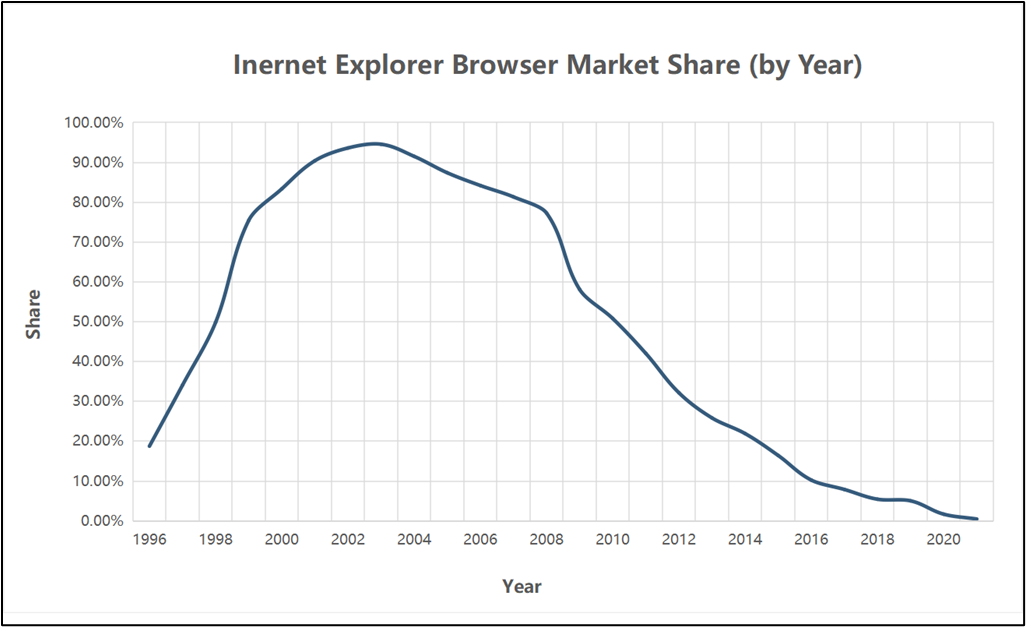
1. IE Browser Market Share by Year(1996 - 2021)
In the early years, Internet Explorer (IE) quickly took the market share, becoming one of the top browsers for years to come, before eventually declining.
| Year | Market Share |
|---|---|
| 1996 | 18.75% |
| 1997 | 34.08% |
| 1998 | 49.84% |
| 1999 | 75.42% |
| 2000 | 83.35% |
| 2001 | 90.41% |
| 2002 | 93.61% |
| 2003 | 94.55% |
| 2004 | 91.50% |
| 2005 | 87.38% |
| 2006 | 84.18% |
| 2007 | 81.33% |
| 2008 | 77.26% |
| 2009 | 58.09% |
| 2010 | 50.79% |
| 2011 | 42.03% |
| 2012 | 32.15% |
| 2013 | 25.83% |
| 2014 | 21.91% |
| 2015 | 16.41% |
| 2016 | 10.24% |
| 2017 | 7.88% |
| 2018 | 5.43% |
| 2019 | 5.03% |
| 2020 | 1.68% |
| 2021 | 0.46% |
The data is taken at the end of Q4 for each year, providing a snapshot of the market's performance at the end of the calendar year.
Internet Explorer dominated the browser market for over 16 years, but its reign ended in 2012 when Google Chrome took over. At its peak in 2002 and 2003, IE held a staggering 95% market share, a record that still stands today. However, the browser's popularity began to decline in 2006, marking the start of its steady weakening.
The program started to show slow browsing compared to its early competitor Firefox, leading to a decline in its market share below 90%.
2. IE Browser Market Share by Version
After version 5, Internet Explorer versions 6, 7, 8, and 9 showed a gradual decline in market share, with each subsequent version experiencing a slight decrease in usage.
| Version | Percentage today |
|---|---|
| 5.5 | 0.01% |
| 6 | 0.01% |
| 7 | 0.01% |
| 8 | 0.04% |
| 9 | 0.06% |
| 10 | 0.01% |
| 11 | 0.57% |
The usage of older versions of a software is almost non-existent, likely due to the fact that many people still use older operating systems, which continue to support these versions. This means that the percentage of users still employing these older versions is mainly contributed by computers running these outdated operating systems.
VI: Well-Known Websites/Services That Drop Supports For IE
Many services have dropped support for Internet Explorer (IE), including GitHub, which stopped supporting IE in July 2018. Microsoft's own services have also stopped supporting IE, and other services such as Google, Facebook, and Twitter have also dropped IE support.
| Website/Service | When |
|---|---|
| WordPress 5.8 | July 2021 |
| Google Search | October 2021 |
| Gmail and Google Workspace | March 2021 |
| GitHub | July 2018 |
| Microsoft 365 | August 2021 |
| Microsoft Teams | November 2020 |
| July 2020 | |
| June 2020 | |
| Salesforce | December 31st, 2020 |
| Internet Archive | June 2020 |
Microsoft has announced that it will stop supporting Internet Explorer (IE) on June 15, 2022, and other programs and services have also stopped supporting IE, including WhatsApp, which stopped supporting IE a while ago.
Microsoft has officially announced that it will no longer be developing Internet Explorer, and instead will focus on its new browser, Microsoft Edge. This means that Internet Explorer will not be included in future Windows 11 updates and builds.
VII: Interesting Stats about Internet Explorer
Here are a few interesting facts and stats about the Explorer that we've covered throughout this article, plus a few more:
- Microsoft made Internet Explorer a direct competitor to Netscape Navigator
- 95% of users accessed the internet through it around 2003, at its peak.
- Microsoft spent over $100 million on Internet Explorer (IE) browsers annually in the late 1990s, a significant investment that underscored the company's commitment to the web browser market at the time.
- Microsoft paid $5 million to settle a lawsuit with SyNet Inc. over the use of the name "Internet Explorer".
- 2019 was the first time Safari surpassed Internet Explorer's market share.
- Microsoft ended support for Internet Explorer in January 2020, after which the company began transitioning users to its newer Edge browser. As a result, Internet Explorer is no longer receiving security updates, feature updates, or technical support from Microsoft.
- Internet Explorer held a majority of the market share until 2012, when Google Chrome surpassed it to become the top browser.
Microsoft's Internet Explorer, a once-dominant web browser, has finally reached the end of its life, retiring on June 15, 2022, after years of use.
VIII: Conclusion
Internet Explorer was the undisputed king of browsers for a long time, with Google Chrome only coming close to its success 17 years after its release. Despite Chrome's popularity, Internet Explorer's dominance lasted for over a decade, cementing its position as the leading browser until it was eventually dethroned.
Microsoft is phasing out Internet Explorer (IE) in favor of MS Edge, which is expected to become the primary browser soon. While Edge is expected to replace IE, it's unclear if it will be as successful or reach the same level of greatness as IE, which was once the leading browser. Currently, Google Chrome is the leading browser.
Related Articles
- How to Stop Windows 11 Update (Block It Forever)
- Rollback from Windows 11 to Windows 10 - 2 Methods
- TOP 10 FREE PHOTO EDITORS LIKE PHOTOSHOP
- How to Use Device Encryption on Windows 11
- How to Fix Error Code 41 Mac When Coping Files on macOS 13/12/11
If you're experiencing a Mac error code 41 while copying files, this article will help you understand what it means, why it occurs, and how to resolve the issue. You'll also find a bonus tip for recovering deleted files on your Mac. - There Was an Error Connecting to the Apple ID Server on MacBook [Fixed👍]
If you've encountered the error “There was an error connecting to the Apple ID server”, this article can provide more information on this issue and possible solutions. If you've lost data while trying to fix this error, consider installing Deep Data Recovery for Mac.
Products
Articles & Tutorials
- Data Recovery
- Data Backup
- File Recovery
- File Backup
- System Backup and Restore
- Disk and Partition Clone
- Technical articles
- Mobile articles
- Disk Master Help
- Windows Data Recovery Tutorials
- Windows Secure Delete Tutorials
- Windows Partition Management Tutorials
- Windows File Backup and Restore Tutorials
- Windows System Backup and Restore Tutorials
- Windows Disk Backup and Restore Tutorials
- Windows Clone Tutorials